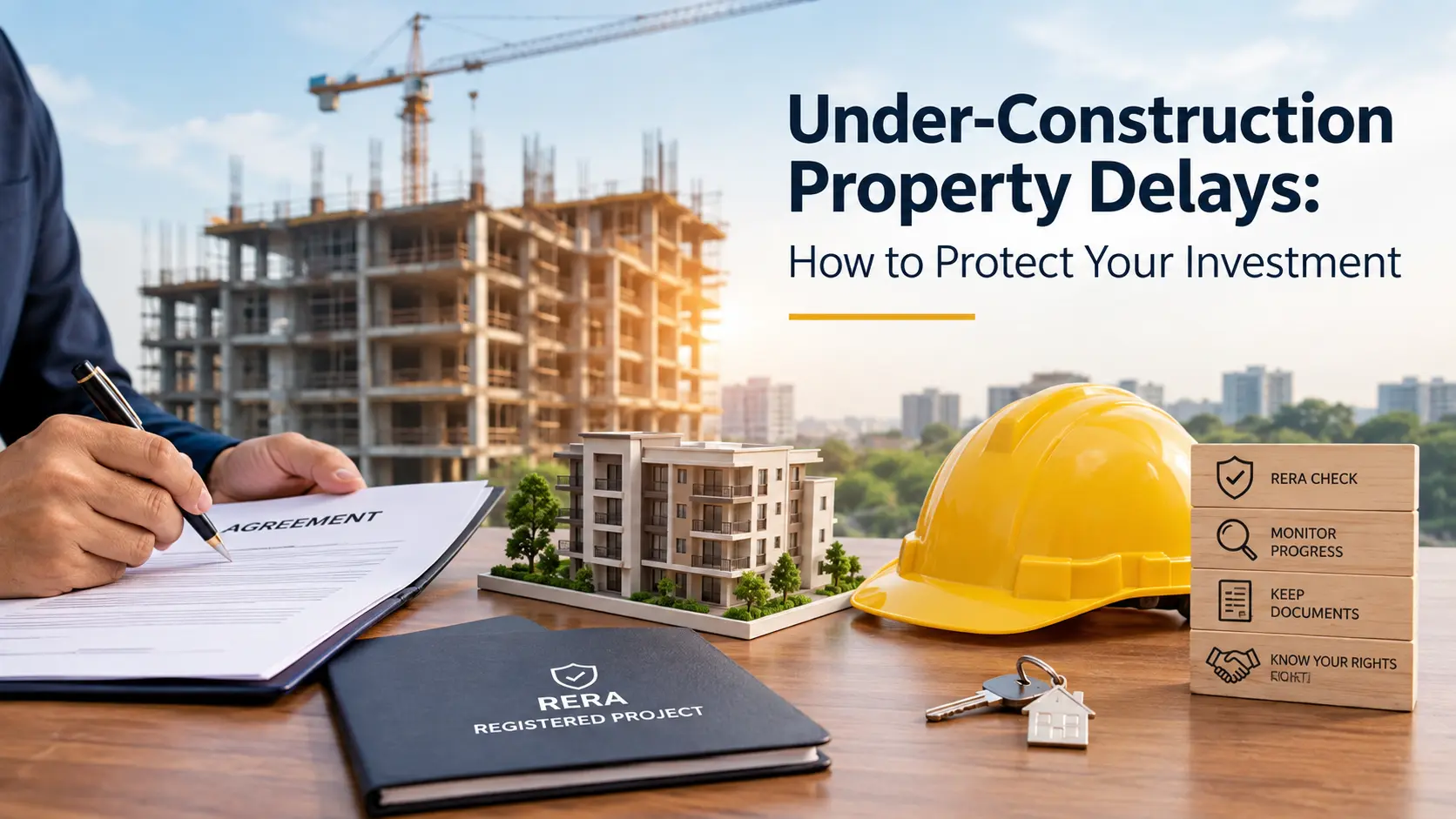
Under-Construction Property Delays: How to Protect Your Investment
If you've ever bought (or thought about buying) an under-construction flat, you already know the pitch: lower price, flexible payment plan, and the promise of owning something in a location that's still coming up. What nobody puts in the brochure is the possibility that you'll be checking the construction site every few months, wondering why the cranes haven't moved.
Project delays are the single biggest headache for under-construction buyers, and it's not always the developer's fault — cash flow problems, pending approvals, contractor disputes, or sometimes just plain bad planning can all slow things down. If you're buying in Noida, Greater Noida, or anywhere else in Delhi-NCR, it helps to know what to look for and what to do if your project is already running late.
Why Do Projects Actually Get Delayed?
There's rarely one single reason. Sometimes it's money — the developer runs short and construction slows to a crawl. Sometimes it's paperwork — an approval that should've taken three months takes eighteen. Other times it's a dispute with a contractor, a change in the building plan, or something genuinely outside anyone's control.
The question you should really be asking isn't "is this project delayed?" It's "why is it delayed, for how long, and what is the developer actually doing about it?" That distinction matters a lot more than most buyers realize.
1. Check the RERA Registration Yourself
Don't take the sales team's word for it — look up the project on the RERA website directly. Every state has its own portal; in UP, it's the UP RERA site, and it lets you check registration status, promoter details, the sanctioned plans, and the declared completion date.
If you're eyeing something in Noida or Greater Noida, pull up this information before you sign anything or hand over a rupee. It takes ten minutes and can save you years of frustration.
2. Don't Trust the Possession Date in the Brochure
The date in the ad or the sales pitch is basically marketing. The date that actually matters legally is the one in your Agreement for Sale and the one filed with RERA — and sometimes these don't match what a salesperson told you verbally.
Hold on to your booking form, allotment letter, agreement for sale, every payment receipt, and any written communication with the developer. You may not need these for years. Then again, you might need them badly, and by then it's too late to go looking for them.
3. Actually Visit the Site — Don't Just Take Their Word
"Possession will be given soon" is one of the most overused sentences in Indian real estate. It means almost nothing on its own.
Go see the site yourself every few months and compare what you find with what was promised. RERA portals also carry construction updates for registered projects, which is worth cross-checking too. If nothing has moved for a long stretch, that's not a coincidence you should explain away — treat it as a red flag until proven otherwise.
4. Know What RERA Actually Lets You Do
RERA exists precisely for situations like this — it gives buyers a framework to raise complaints and, where warranted, claim compensation. UP RERA runs a proper complaint mechanism for exactly this purpose.
Depending on your specific case, your agreement, and how badly the timeline has slipped, you might be entitled to interest, compensation, or in some situations, a full withdrawal with refund. Every case is different though, so this is genuinely a moment to talk to a lawyer rather than guess based on what you've read online (including this).
5. Please Don't Just Stop Paying Your EMI
This one's important. It's brutal to be paying an EMI on a flat you can't move into while also paying rent somewhere else — that financial squeeze is real, and it's exhausting.
Keep records of your EMIs, your rent payments, and everything you've exchanged with the developer — you'll want this if you ever need to demonstrate financial loss.
6. Build a File. An Actual File.
Keep everything in one place:
- Booking form and allotment letter
- Agreement for Sale
- Payment receipts
- Loan documents from your bank
- The possession commitment, in writing
- RERA registration details
- Construction progress updates
- Emails and letters to and from the developer
- Any complaints or notices you've sent or received
- Photos and videos from your site visits
This sounds tedious until the day you actually need it — and on that day, you'll be very glad you have it.
8. Know the Difference Between "Slow" and "Seriously Wrong"
Some delays are ordinary — construction is genuinely complicated, and a few months' slip isn't automatically a scandal. But a few signs should worry you more than others: construction that's been dead for a long stretch, a developer who keeps pushing the possession date back without explanation, project information that's gone quiet, or emerging legal or financial trouble.
UP RERA has stepped in before on projects that were effectively stalled with no real movement toward completion. And there's a scenario worth knowing about specifically: if a project ends up in Corporate Insolvency Resolution proceedings, your case essentially moves out of the usual RERA process and into the insolvency framework — meaning you may have to file your claim with the appointed Insolvency Resolution Professional instead. It's a different process, and buyers are often caught off guard by it.
9. The Best Fix Is Not Buying Into a Delay-Prone Project in the First Place
All of the above matters, but honestly, the cheapest way to deal with delays is to avoid buying into a risky project to begin with.
If you're comparing options for a **property in Noida**, it's worth putting a few projects side by side and looking specifically at how well each one is actually executing — not just how good the sales pitch sounds.
What If Your Property Is Already Delayed?
Start by pulling together every document you have and checking the current status on the relevant RERA portal. Then write to the developer — not a phone call, an actual written request — asking for a clear explanation and a revised timeline.
If what comes back doesn't satisfy you, that's the point to speak with a real estate lawyer and look into the complaint, compensation, or conciliation options available to you. And whatever you do, don't make a big financial decision based on someone's verbal reassurance over the phone.
The Bottom Line
Under-construction property can still be a smart investment — but execution risk deserves just as much attention as price and location, arguably more. Verify the RERA registration, know your actual contractual possession date, keep checking on progress, hold on to your paperwork, and act early if something feels off rather than waiting it out.
At **Propseekers Realty**, we help buyers evaluate residential and commercial opportunities across Noida and Delhi-NCR, with real attention to project suitability, location, and how well an investment actually fits what you're looking for.
**Looking for a property in Noida? Let's find options that actually match your investment goals — and do the due diligence properly before you commit.**